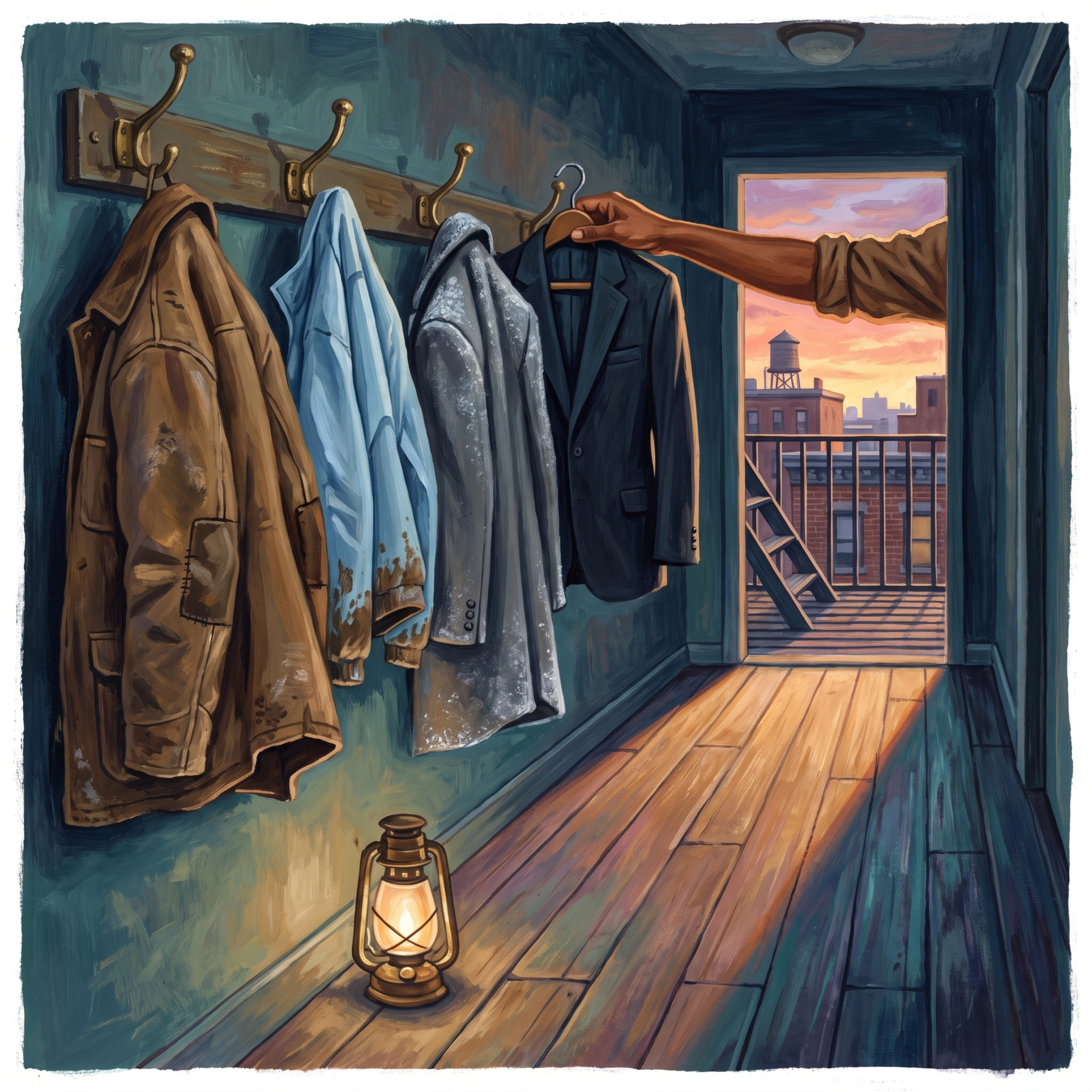
Thank You, Survival Mode: Why We Freeze, Fight, and People-Please
About this episode
Ever freeze, people-please, or snap when you feel unsafe, then blame yourself later? Those reactions are your body trying to protect you. Peer specialist Antonio Matta explains why they happen and shares a simple 10-minute practice to help you feel calmer and more in control.
--------
A solo journalistic commentary on the Recovery Dialogues and Sober Stories podcast, where lived experience meets clinical insight and the overlooked truths of trauma recovery get a fair hearing.
In this episode:
• Why freezing is involuntary, and why it deserves compassion
• What concept creep research says about trauma talk online and mental health stigma
• The identity trap: when a trauma story becomes the whole self
• Substance use as a stress response in addiction recovery, and the addiction culture that reads survival as character
• Why resilience is the most common outcome, and what peer support adds to mental health recovery
• The Retirement Interview: a self-directed recovery practice for fight, flight, freeze, and fawn
00:00 Recovery is possible
00:32 Why does my body react before I can think?
01:40 Is it safe to listen to a trauma recovery episode right now?
03:35 Why did I freeze? What trauma responses are for
05:41 Is everything I do a trauma response now?
08:03 What if my trauma becomes my whole identity?
11:26 Why does the world read my survival mode as a personality flaw?
14:19 Can I recover from trauma, and do I have to do it alone?
17:28 How do I calm my fight, flight, freeze, or fawn response?
20:38 What do I want to remember from today?
21:44 Where do I go from here?
Whether you're in addiction and mental health recovery, offering sobriety support to someone you love, working on self improvement without self-blame, or a clinician looking for fresh language for mental wellness, this one's for you.
Need addiction help or support right now? Call or text 988 (Suicide and Crisis Lifeline), or call the SAMHSA National Helpline at 1-800-662-4357, free and confidential, every day.
Support the show: https://gofundme.com/recoverydialogues
Merch With Meaning: https://recoverydialogues.com
No Means No, a memoir by R. Antonio Matta: https://a.co/d/044UMaPd
Sponsor an episode or season: https://recoverydialogues-soberstories.show
Hosted by Antonio Matta, trauma-informed certified peer support specialist. This episode is educational and doesn't replace care from a licensed professional.
Transcribed automatically by PodView
Recovery is possible. Recovery is possible. Recovery is possible. Recovery dialogues and sober stories.
Somebody raises their voice in the next room, and before you've decided anything, your shoulders are up around your ears and you're already rehearsing an apology for something you didn't do. Your body moved first. Your mind showed up a few seconds later, holding a clipboard, trying to figure out what just happened. For a long time, the only words most of us had for that moment were harsh ones. Overreacting. Too sensitive. Difficult. Lately, the culture handed us new words. Fight. Flight. Freeze.
Fawn. Trauma response traveled from the therapy room to the comment section. And now people use it for everything from a panic attack to ordering takeout three nights in a row. So today, I want to slow that phrase down. What a trauma response is. What the research says it's for. where the public conversation gets it right, where it quietly starts to hurt us, and how a person moves from surviving towards something that feels like living.
Welcome back to Recovery Dialogues and Sober Stories. I'm Antonio Matta, trauma-informed certified peer support specialist, and this is the show where lived experience and clinical insight sit down at the same table. For the last two months, you heard from guests. In August, Cynthia let us inside the moment her care ran out. In September, Russell carried 30 years of recovery into the room, and Dr. Sylvie Stacey helped us understand what the research can and can't see. This month, it's you and me, with my journalist's notebook open and my peer's chair pulled close.
Before we go any further, a word of care. We're going to talk about trauma in general terms. I won't describe anything graphic, and you're welcome to pause, step outside, or come back to this later. Pausing is a skill, and you're allowed to use it on me. A little later, I'll share a few lines from my own memoir, which is about surviving sexual assault. I won't describe what happened, and you're welcome to skip ahead. I also want to be clear about my lane. I'm a peer, which means I bring lived experience, training, and a lot of reading.
And I'll tell you where every big claim comes from. I'm not your therapist, and nothing in this episode replaces care from someone who knows your story. Treat what you hear today as a map you can carry into those conversations. Here's where we're headed. I've got five ideas for you. First, what a trauma response is, in plain language. Second, what happened when the phrase went viral. Third, the quiet risk of a name turning into a home. Fourth, why your surroundings decide which responses stick around.
And fifth, what the evidence says about healing and why it so often happens between people. Then we'll get practical with something I call the retirement interview, a way to sit down with a survival pattern and give it a new job.
Let's start with the part that bears repeating, because a lot of people still haven't heard it said kindly. Researchers who study fear describe something called the defense cascade, a chain of automatic responses that switch on when the brain senses danger. Kasia Kozlowska and her colleagues laid it out in the Harvard Review of Psychiatry back in 2015. We get alert, we get ready to fight or run, and when neither seems possible, we go still. That last one deserves a moment. Freezing and shutting down can feel, afterward, like a personal failure.
You replay it, asking why you didn't move or why you didn't say something. The research points somewhere gentler. A 2011 study in the journal Biological Psychology measured a state called tonic immobility in trauma survivors, a kind of full-body stillness, and concluded that it's preserved in humans as an involuntary defensive strategy. Involuntary means it happens to you, the way a flinch does. Your body chose before you could. So when I say a trauma response is a survival response, I mean it literally.
Fight is the body saying, I can push this back. Flight says, I can get away. Freeze says, maybe if I'm still enough, this passes. And Fawn, a word therapist Pete Walker helped bring into the conversation, says, if I keep everyone pleased, maybe I stay safe. Each one is a strategy, and at some point, each one may have worked. Where it gets complicated is the timing. These responses are built for emergencies, and they don't always get the memo when the emergency ends. A slammed door today can still get treated like a slammed door from 20 years ago.
The alarm stays loyal to an old address. That's the first thing worth repeating as often as it takes. The response made sense somewhere, and healing starts with finding where. Now, the journalist in me wants to step back and look at the bigger picture. Over the last several years, trauma language spread faster than almost any other piece of psychology. You find the four Fs on posters in school hallways in workplace trainings and in 15 videos with a million views Some of that is a gift Psychologist Nick Haslam has spent years studying what he calls concept creep the way our words for harm stretch to cover more ground over time.
In a review published this year with Jesse Say, he argues that the stretching has real benefits. It wears down stigma, and it nudges people toward asking for help. If a young woman learns the word fawn and finally understands why she can't say no to anyone, that word did something good. The same review names the cost. When a concept stretches far enough, it can feed self-diagnosis and make serious problems sound trivial. There's evidence for that second part, too. Across five experiments with more than 1,800 people, Haslam's team found that when participants saw mild, everyday examples labeled as trauma, they started rating trauma itself as less serious.
Sit with what that means for someone living in real survival mode. When trauma response becomes the punchline for skipping the gym, the person who freezes every time a landlord knocks gets taken a little less seriously by everyone, and sometimes by themselves. I'll add one more note in the spirit of honesty. A lot of popular nervous system language, the talk about vagal states and ladders, comes from a theory that researchers are actively challenging. In 2023, psychophysiologist Paul Grossman published a detailed critique arguing that the core premises of polyvagal theory don't hold up against the evidence.
You can still find those metaphors useful, and plenty of people do. Hold them the way you'd hold a hand-drawn map. Helpful for finding your way and worth checking against the ground under your feet. So what do we do with all this? Use the words. They're doors. And then stay with me for this next part, because a door can turn into a room you never leave.
This is the part I rarely hear anyone say out loud, and I think it matters most. Back in 2007, two memory researchers, Dortha Bernson and David Rubin, published work on a tool called the Centrality of Event Scale. It measures how much a painful event has become a turning point in someone's life story and a key to who they believe they are. Across their studies, the more central the trauma had become to a person's identity, the more severe their PTSD symptoms tended to be, even after accounting for anxiety and depression.
Later research with combat veterans found the same pattern. That's a correlation, which means the two travel together. It can't tell us which one came first. I also want to handle it with care, because a finding like this can get twisted into, just get over it, and I'd never say that to you. What happened to you matters. Your story deserves to be told, witnessed, and believed. What the research suggests is subtler. Naming a pattern helps you see it. Building your whole sense of self around that pattern can keep you living inside it.
So, I'll offer you a different picture. Think of your trauma responses as employees hired during a crisis. They worked double shifts and slept at the office, and some of them kept you alive. When the crisis ends, firing them feels like betrayal. And pretending they never worked there doesn't hold up either. What you can do is sit down with each one, thank it, and hand it a new job description. Therapists who use internal family systems describe something close to this. In that model, the parts of us that rush in to protect get met with curiosity and appreciation.
And the work often begins by asking what they're afraid would happen if they stepped back. When someone moves from, I'm broken, to part of me learned to freeze and it was trying to help, something in the room changes. Their shoulders come down an inch. That inch is where recovery gets in. I know this one from the inside. In my newest memoir, No Means No, I wrote about a silence I carried for decades, all the way into therapy. The book is about surviving sexual assault as a man and about the 30 years it took me to say so out loud.
For 30 years, I sat in therapists' offices and talked about depression, abandonment, diagnoses, and hospitals. I circled the hardest truth so faithfully that I mistook the circling for arrival. For a long time, I believed that silence meant I'd failed at therapy. Now I understand it differently. Silence can be an old form of intelligence. A child without protection learns quickly which truths a room can hold, and my silence became a private security system that kept the story where no one could mishandle it.
The system works until it doesn't. Mine protected me from other people's reactions while leaving me alone with my own. And the moments when my body went still in danger? I used to read that stillness as a signature, a moral document filed against myself. It took decades for a simpler truth to reach me. My body was trying to survive. So I thank that old silence for its service. And I've stopped giving fear the final vote. Now let's widen the lens, because this is where recovery dialogues and sober stories always ends up.
Who gets to heal and why? In March of this year, researchers Angel Algarin, Ji Young Lee, and Xiangming Zhan published a review in current addiction reports called Fight, Flight, Fawn, Freeze, rethinking substance use through a stress response lens. I wish every treatment program would tape its core argument to the wall. They describe each response as a distinct mode of survival and they argue that which one a person reaches for depends heavily on context what their environment allows rewards or punishes Fawning they note shows up more where stigma and discrimination are common, and they call on prevention and treatment to move beyond individual-level pathology.
Picture what that looks like in real life. A person who freezes in a doctor's office may get charted as non-compliant. A person who fawns through an intake interview saying yes to everything may get written up as doing great a person whose fight response flares in a shelter line may get labeled aggressive and asked to leave again and again the system reads a survival strategy as a personality then responds to the personality substance use belongs in this conversation too that same review places avoidance and using to numb out in the freeze family, a way of shutting down when nothing else feels possible.
And researchers have documented for years how often PTSD and alcohol misuse travel together, often enough that a 2014 systematic review recommended screening for one whenever the other shows up. If you've ever used to get through a feeling, please hear this without shame. Your use may have been doing a job, and that job can be handed to something gentler. The weather inside a person and the weather around them have always been in conversation. Calm rooms make calmer bodies easier. Unsafe rooms keep old alarms ringing.
So healing has an inside part and an outside part, and anyone who sells you only one of them is selling half a map. That's also why the Substance Abuse and Mental Health Services Administration, SAMHSA, built its trauma-informed approach around six principles that are mostly about environments. trustworthiness and transparency, peer support, collaboration and mutuality, empowerment, voice and choice, and attention to cultural, historical and gender issues. Listen to what's sitting right in the middle of that list.
Peer support. People who've been there. Written directly into the definition of trauma-informed care. Let's talk numbers for a minute, because they carry a kind of hope that rarely makes headlines. The World Health Organization's World Mental Health Surveys asked nearly 69,000 people in 24 countries about their lives. About 70% reported at least one traumatic event, and the average person reported more than three. So if you've been through something, you're in the majority. Now the other side of that coin.
In the same survey program, lifetime PTSD showed up in about 4% of everyone surveyed and in about 5.5% of people who'd been exposed to trauma. Most people who live through terrible things carry the memory and still find their footing. Psychologist George Bonanno, who has studied this for decades, puts it plainly, resilience is the most common outcome after a potentially traumatic event. He describes it as flexible self-regulation, being able to reach for different coping moves in different moments and notice which ones are working.
I want to slow down here because numbers like these can land wrong. If your symptoms stayed, you belong in this conversation just as fully. Lingering symptoms usually reflect how much a person was carrying for how long and how much support was around them. And the same research that gave us that 4% found something that should make all of us angry. Only about half of the people with severe PTSD reported getting any treatment at all. A lot of what looks like someone not healing is someone who never got the chance.
When healing does happen, it very often happens between people. A 2020 meta-analysis in BMC Psychiatry pooled 19 trials of one-to-one peer support covering more than 3,000 participants. The researchers found modest, real improvements in empowerment and in people's own sense of recovery, while clinical symptoms stayed about the same. To me, that says peer support and clinical care do different jobs, and you deserve both. Treatment works on symptoms. Peers bring something harder to measure. Sitting across from someone who survived a version of your story and is still here.
One of the most widely taught peer approaches, intentional peer support, puts mutuality and trauma awareness at its center. Relationships built as equals where both people learn. Fight, flight, freeze, and fawn all switch on when we feel alone with a threat. Connection is the condition where they can finally stand down. And sometimes, further down the road, people describe growth, deeper relationships, new priorities, a strength they didn't know they had. Researchers call it post-traumatic growth, and a 2019 meta-analysis found that moderate to high growth is reported by a large share of trauma survivors.
Growth is never a requirement, and nobody owes their pain a silver lining. It's simply one more sign that the story keeps going.
Okay, let's make this usable. I call this practice the retirement interview, and you can do it in a notebook, in the notes app on your phone, or out loud on a walk. It takes about 10 minutes. Start with something small and recent, a moment that felt like a 3 out of 10, so you're practicing on a pebble before you try a boulder. Step 1 is to notice the body. Pick a recent moment when you reacted faster than you meant to and ask what your body did. Was your jaw tight Your voice gone Your legs ready to bolt Or did a smile show up before you agreed to anything Describe it the way you describe the weather Step two is to name it in plain words Which employee clocked in?
Fight, flight, freeze, or fawn? Some moments use more than one. Say a sentence like, part of me went into fawn. That word part matters. It reminds you there's more of you in the room. Step three is to ask about the job. Ask that part. What were you protecting me from? When did you first learn to do this? What are you afraid would happen if you took a break? You may not get a clear answer, and that's okay. Curiosity alone changes the temperature. Step four is to offer one small new duty, something tiny, reversible, and doable today.
If fight showed up, try an exhale that's longer than your inhale and give yourself permission to say, I need 10 minutes and I'll come back. If flight showed up, try staying for one more breath or finishing one small task before you leave the room. If freeze showed up, start at the edges. Press your feet into the floor, wiggle your fingers, and slowly look around and name three things you can see. And if fawn showed up, practice one sentence that buys you time. Like, let me think about that and get back to you.
Step five is to bring it to a person. Read what you wrote to someone who feels safe, a peer, a sponsor, a therapist, a friend who doesn't flinch. Survival patterns formed when you felt alone with something, and they tend to soften faster when somebody is with you. If you've spent time with dialectical behavior therapy, you may recognize the destination here. DBT talks about wise mind, the place where feeling and reasoning meet. The retirement interview is a small daily walk in that direction. And please hear this part.
If you're having flashbacks that take over your day, losing chunks of time, using more to get through, or having thoughts of not wanting to be here, that's a signal to bring in more support now. In the United States, you can call or text 988 anytime to reach the Suicide and Crisis Lifeline. The SAMHSA National Helpline is free, confidential, and open every day at 1-800-662-4357. If you're in immediate danger, call 911. Reaching out is a survival skill too. Maybe the best one we've got.
Let's bring it home. Today we covered five ideas. First, trauma responses are survival strategies, and freezing in particular is involuntary, so it deserves compassion, never blame. Second, the public conversation gave us helpful words, and research on concept creep shows those same words can lower stigma while blurring how serious real trauma is. Third, naming a pattern helps, while letting it become your whole identity is linked with heavier symptoms, so we thank our survival responses and give them new jobs.
Fourth, context shapes which responses stick, and systems too often read survival as personality. And fifth, most people find their footing after trauma. Healing usually happens in relationship, and peer support adds empowerment and a felt sense of recovery. You also have a 10-minute tool in your pocket. Notice, name, ask, offer, and bring it to a person.
If today gave you a word, a number, or a moment of recognition, the most generous thing you can do costs nothing. Share this episode with one person who needs it. Follow the show and leave a rating wherever you're listening. For an independent show like this one, that single action does more than most people realize. Recovery Dialogues and Sober Stories runs almost entirely on people like you. If you're able to give, you'll find the show's GoFundMe at gofundme.com slash recovery dialogues. And every dollar goes back into keeping these conversations honest, accessible, and free.
If you're part of an organization, a treatment center, or a practice whose mission feels aligned with this one, reach out. I'd welcome a conversation about sponsoring an episode or a season. If you're a clinician or a leader inside a treatment organization and something today has you thinking about how your own team talks about trauma, that's also work I do outside this mic, helping behavioral health organizations put their clinical voice into words people can feel. You can also support the show through Merch With Meaning at recoverydialogues.com.
Hoodies, tees, joggers, mugs, even plush companions, each one carrying an original design and built around the show's recovery mantras. Every piece is a small, wearable reminder that somebody, somewhere, made it through. And if today's episode stirred something, my newest memoir, No Means No, written under the name R. Antonio Mata, goes deeper into the silence I talked about earlier. It's a hard read in places, so please take care of yourself if you pick it up. Details are in the show notes. Before I go, a look down the road.
Back in September, Dr. Stacey mentioned how gambling can quietly take hold when life loses its structure. And in the coming months, I'm hoping to give that conversation the room it deserves. Gambling addiction, one of the most hidden addictions in recovery, living right there on the phone in your pocket. Stay subscribed so you're here when it lands. Wherever you are tonight, whatever part of you clocked in today to keep you safe, it's allowed to rest now. Thank it and give it a lighter shift. I'm Antonio Mata.
Recovery is possible. Let's prove it one story at a time.




 Apple Podcasts
 Castbox
 Castro
 Goodpods
 Moon FM
 Overcast
 Pocket Casts
 Podbean
 Podcast Addict
 Podcast Republic
 Spotify
